Edited by GUDIAN Water · AI-assisted compilation and review · Sources checked: 2026-10-21
When reading about a new membrane material, intelligent model or removal rate, first identify the study subject, validation scale and control conditions. This introductory guide draws on institutional websites and was checked on 21 October 2026. Sources from 2024—2026 retain their original publication dates; older studies are not presented as this week's news.
1. New-material and data research at Yunnan universities
On 8 October 2026, Yunnan University reported research on catalytic microenvironments and selective removal of emerging contaminants, including continuous-flow validation under the tested conditions. Further questions include how target pollutants, real background constituents, material leaching and effluent assessment were set up. Continuous-operation research does not establish validation for every campus drinking-water scenario.
A Kunming University of Science and Technology report dated 8 June 2026 emphasised historical lag features in hourly water-quality data from one plant. Strong test-fit performance must be interpreted in its time-series and data-source context. It does not show that the model already works at another university or can directly control equipment.
2. Membrane separation and catalysis involve different mechanisms
On 19 January 2024, Tsinghua University described research combining membranes and catalysis. Distinguish pollutant retention, transfer to the concentrate side and chemical transformation. A falling target concentration must also be understood alongside by-products and subsequent fate.
Further checks include feed composition, test duration, flux and pressure difference, material stability and post-treatment assessment. Research materials and ordinary commercial membrane elements are not interchangeable merely because both are called “membranes”. Reported experimental results must not become performance promises for equipment on this site.
3. AI-assisted membrane design: examine the link between data and mechanisms
A framework described by Zhejiang University's institute for ecological civilization on 9 September 2025 combines data and mechanisms, using molecular features and physical mechanisms to understand relationships between organic micropollutants and membranes. This addresses material design, not automatic diagnostics built into drinking-water equipment.
Record training subjects, test splits, performance on unseen subjects and experimental validation when reading model results. Field applications additionally require checks of available data and responsibility boundaries. A content-generation tool is not a site PLC or chemical-dosing controller.
4. Solar desalination: distinguish the source water and process first
On 8 October 2024, MIT reported an electrodialysis prototype that adjusts operation with photovoltaic power, tested on brackish groundwater. It is not the same task as seawater RO or round-the-clock continuous supply. A trial requiring no additional storage batteries does not mean unconditional or cost-free water supply.
Further comparisons should include source salinity, solar conditions, product-water storage, night demand and whole-system cost. One energy-utilisation indicator does not automatically represent total system efficiency or results achievable at every location.
5. Emerging-contaminant removal: track where the substances go
A Chinese Academy of Sciences report dated 2 September 2025 discussed PFOA mineralisation and fluoride immobilisation through interactions between microdroplets and mineral particles. Distinguish the treatment target, mineralisation, residues and by-products. Research on a specific substance does not mean all PFAS have been addressed.
Procurement discussions must start with actual test results and treatment needs. Such reports do not establish that a local source has the specific contamination, nor that a general-purpose cartridge has the research system's capability. Specialised contamination treatment and waste handling need a corresponding professional plan.
6. New high-salinity wastewater processes: read the limitations closely
On 7 July 2026, the Chinese Academy of Sciences reported bench-scale research on thermoresponsive ionic-liquid-assisted OARO concentration of high-salinity wastewater. The report explicitly states that, with the current materials and process conditions, energy consumption per unit of product water remains higher than in the conventional inorganic-salt-based reference system.
Application potential and demonstrated lower electricity use are different conclusions. Assess draw-solution recovery, polishing, residues and total energy together. Improvement in one subprocess does not establish low-cost commercialisation of the entire process.
7. Turn reading leads into evidence for the next discussion
Keep the study title, institution, publication date, original source, study subject and validation scale, then list what remains unproven separately. Conditions in the original paper require checking against that paper. This guide has not reproduced the studies or conducted independent engineering validation.
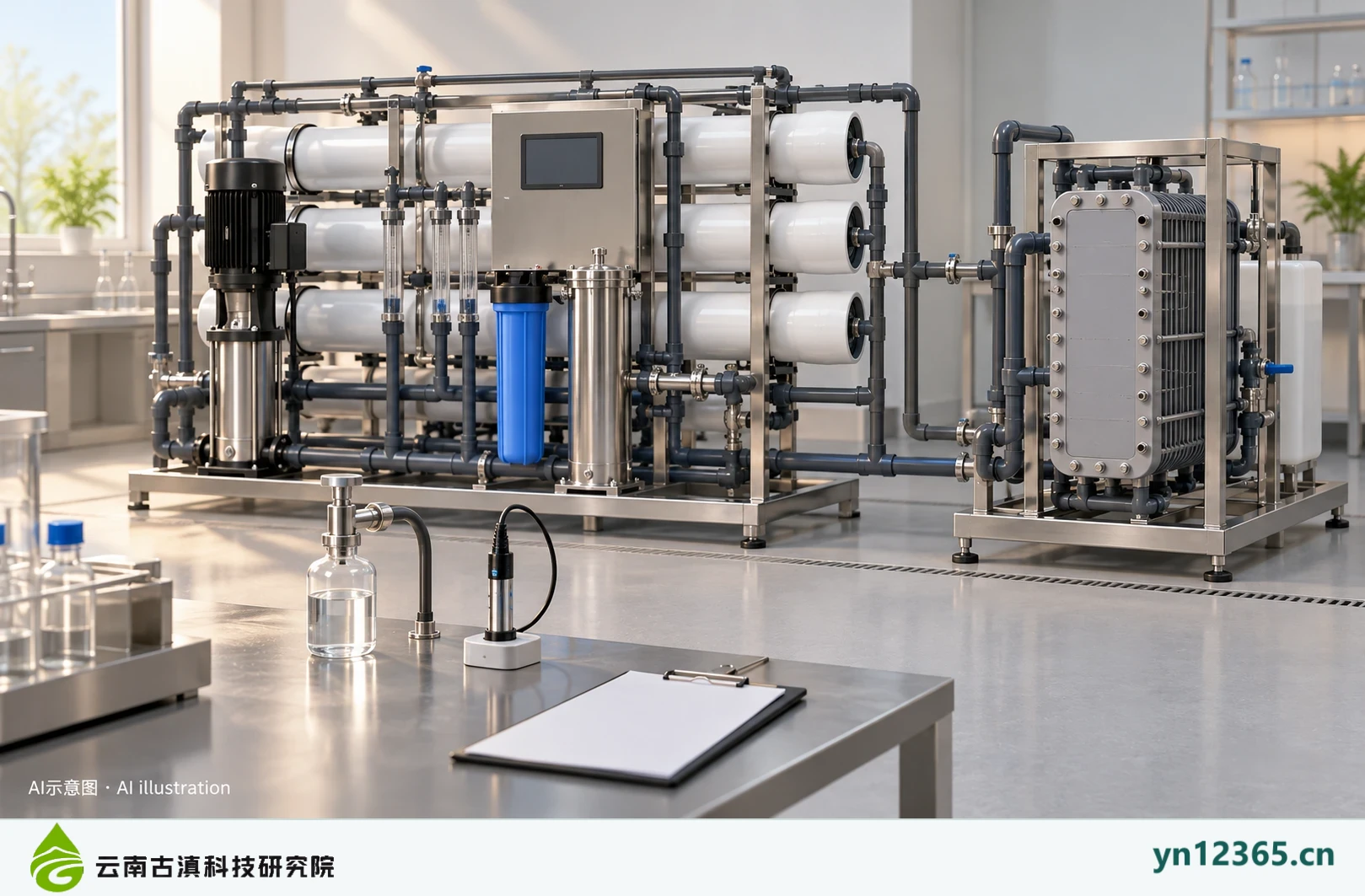
Institution names identify sources; they do not indicate GUDIAN Water cooperation, authorisation or endorsement. Images are existing AI equipment illustrations from this site, not university laboratories, research apparatus or project photographs. Laboratory water requirements must still be confirmed against specific methods and instrument documents.
| Reading level | What to record | Next step |
|---|---|---|
| Institutional report | Research direction, publication date and paper leads | Find the original paper and validation conditions |
| Experimental results | Subjects, controls, scale and limitations | Check whether results can transfer to the actual task |
| Proposed engineering application | Actual feedwater, use, site and responsibilities | Have the relevant personnel design a validation plan |
| Procurement and rental | Models, scope, maintenance and acceptance evidence | Compare and confirm under university procedures |
Frequently asked questions
Can university research be described as GUDIAN Water's own technology?
No. Distinguish research, institutional reports and this site's capabilities clearly. Cooperation or authorisation needs genuine evidence.
Does a high removal rate in a paper justify promising compliant drinking-water equipment?
No. Study subjects, processes and validation conditions are not acceptance evidence for specific equipment or site water quality.
Do research advances directly determine what a university should buy or rent?
They help frame questions. A specific proposal still needs experimental uses, water quality, site conditions, budget, maintenance and university procedures to be confirmed together.
Sources and reading scope
The sources below help explain historical requirement structures; notices do not mean applications remain open. Research news reports do not establish experimental replication or field validation. University, institution and standard names identify sources only, not cooperation, authorisation, certification or recommendation. No third-party figures or tables have been reproduced.
- Jiang Fengzhi's team reports progress in proton-gated catalysis and selective removal of emerging contaminants from water; Yunnan University, 2026-10-08. University report on catalytic microenvironments and continuous-flow validation; not evidence of GUDIAN Water, cooperation or commercial performance.
- Liu Zewei and Li Bin's team reports progress in high-accuracy effluent water-quality prediction; Kunming University of Science and Technology, 2026-06-08. Hourly data from one plant, historical lag features and parameter-specific predictions; cannot be extrapolated to automatic control across campuses.
- Zhang Zhenghua's team reports progress towards overcoming the membrane permeability–selectivity trade-off; Tsinghua University, 2024-01-19. Report on combined membrane and catalytic processes; experimental removal rates are not cited as equipment promises on this site.
- Research report on data- and mechanism-driven water-purification membrane design; Institute for ecological civilization at Zhejiang University, 2025-09-09. Membrane-material design combining data and physical mechanisms; not a function already present in ordinary drinking-water dispensers.
- Solar-powered desalination system requires no extra batteries; MIT News, 2024-10-08. Photovoltaic direct-drive electrodialysis prototype and field trials using brackish groundwater; not seawater RO, round-the-clock supply or a commercial cost commitment.
- Researchers Realize Perfluoroalkyl Mineralization Using Charged Microdroplets; Chinese Academy of Sciences English website, 2025-09-02. Report on mineralisation and fluoride immobilisation under specific research conditions involving PFOA and related work; no claim that general-purpose cartridges remove all PFAS.
- Progress in thermoresponsive ionic-liquid-assisted membrane concentration of high-salinity wastewater; Chinese Academy of Sciences / Hefei Institutes of Physical Science, 2026-07-07. Bench-scale experiments, solute recovery and process-energy assessment. The report explicitly notes higher energy per unit of product water than the inorganic-salt control under current conditions; this limitation must be retained.
Continue reading
- Can university laboratory water systems be rented? Define experimental uses and point-of-use requirements first
- Acceptance of university drinking-water rental: specify maintenance records, fault recovery and exit handover
- Illustrated guide and requirements checklist for 20 water-use applications
- The difference between laboratory membrane materials and commercially available elements
- Field-validation boundaries for AI water-treatment research
University rental and service scopes must be confirmed against actual requirements, equipment documents, university procedures and resources that can be delivered. Use the website contact page to organise uses, campus addresses, points and schedules first. This article makes no claim of available equipment, signed projects, prices or on-site attendance.
Image note: the cover is an existing AI-assisted equipment illustration, not a photograph of a university, research apparatus or project.
Discuss your information:
Contact and enquiries