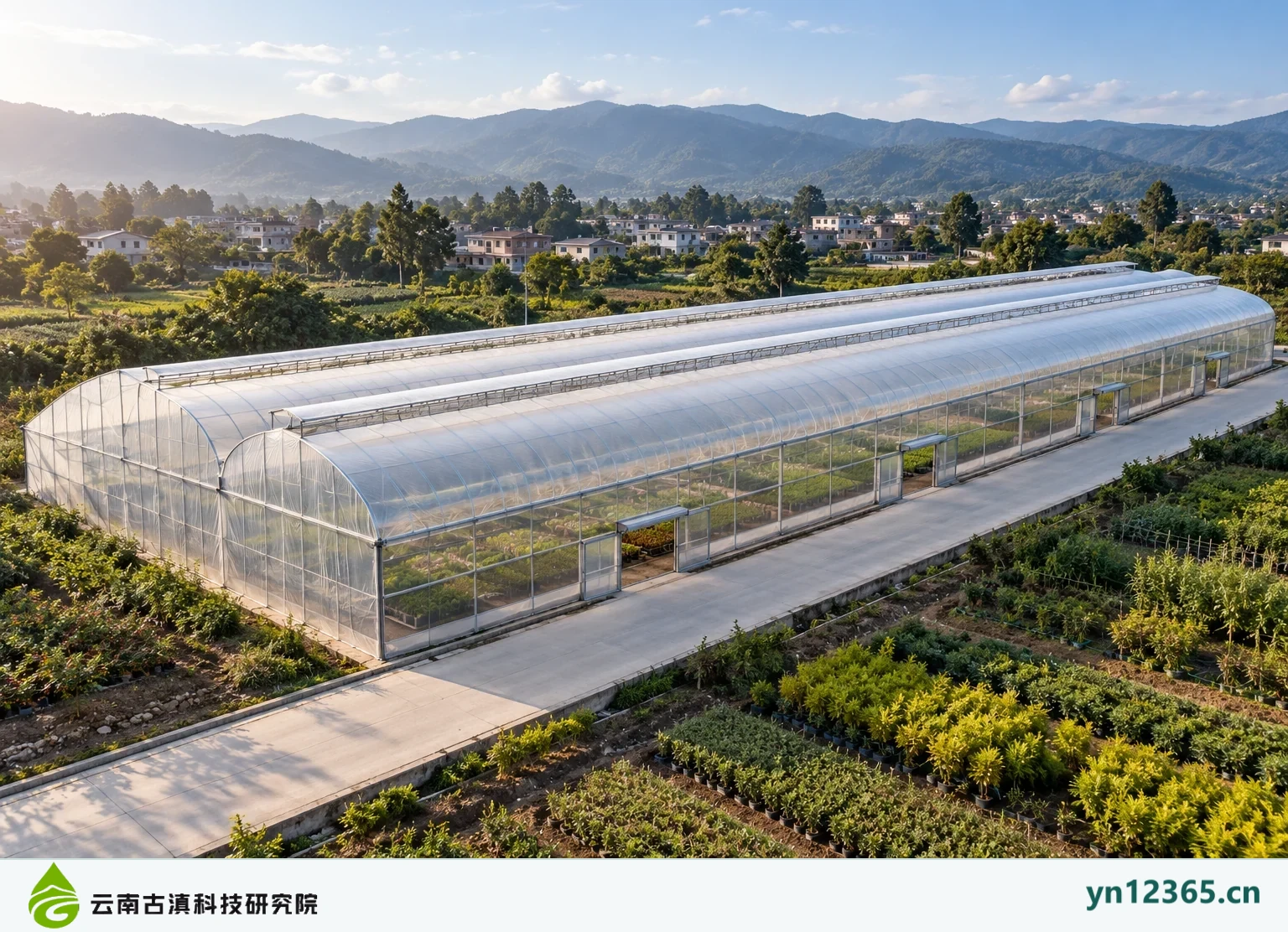
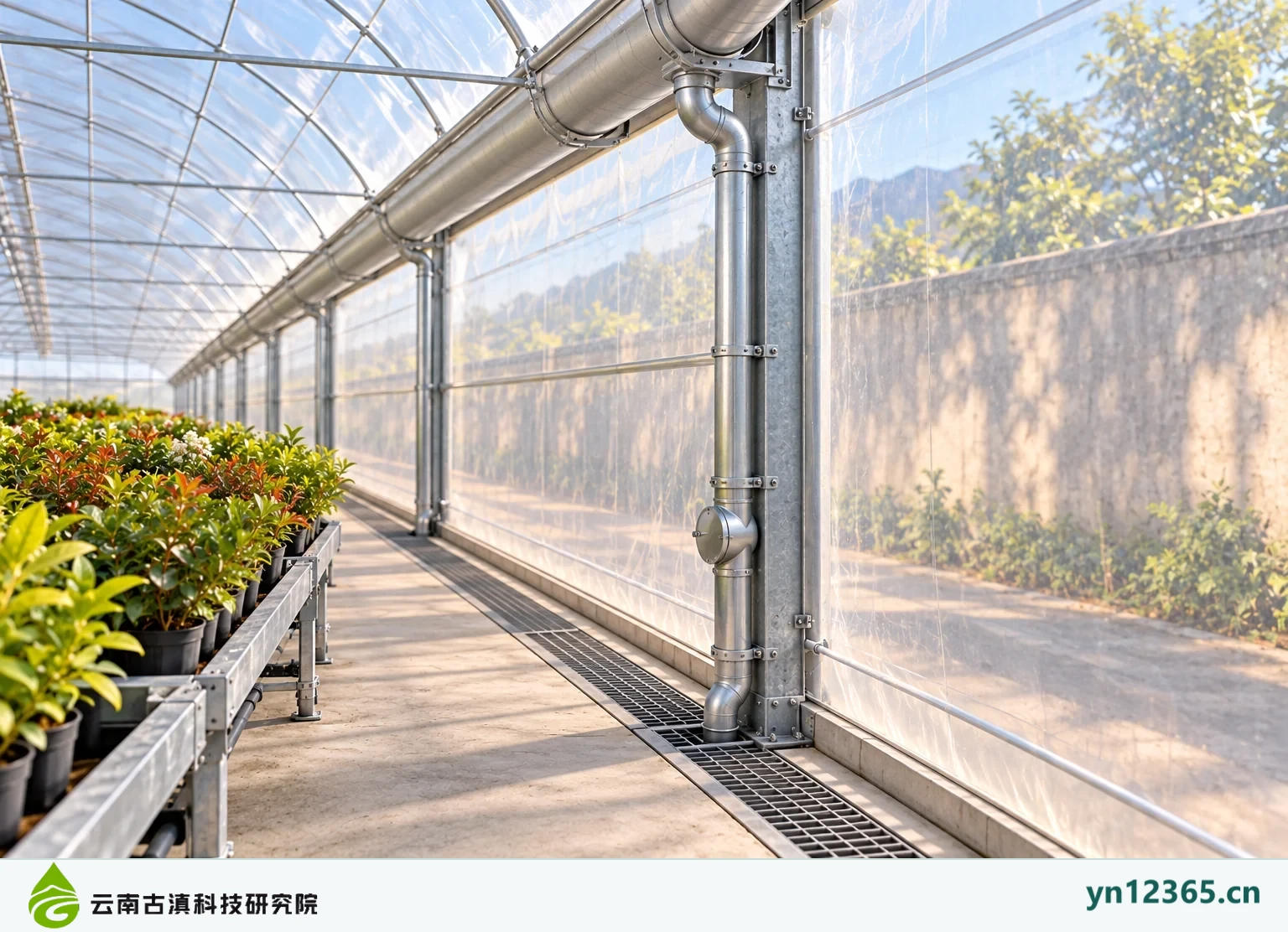
Project stage: planning and preparation. This article records design ideas for GUDIAN Water’s own site. Construction, procurement, installation and production trials have not started. All images are AI-generated design visualizations; the surroundings, plants, equipment and interfaces are not site photographs or items already installed.
GUDIAN Water plans to develop nursery propagation, container-grown fruit trees and agricultural-water trials gradually at one site in Shangliqi Village, Changshui Subdistrict, Kunming. One strand will build its own propagation and growing records. The other will investigate filtration, water preparation and maintenance for different source waters, crops and production stages, then use evidence-based experience in water-treatment equipment and supporting services.
Site conditions and the proposed greenhouse
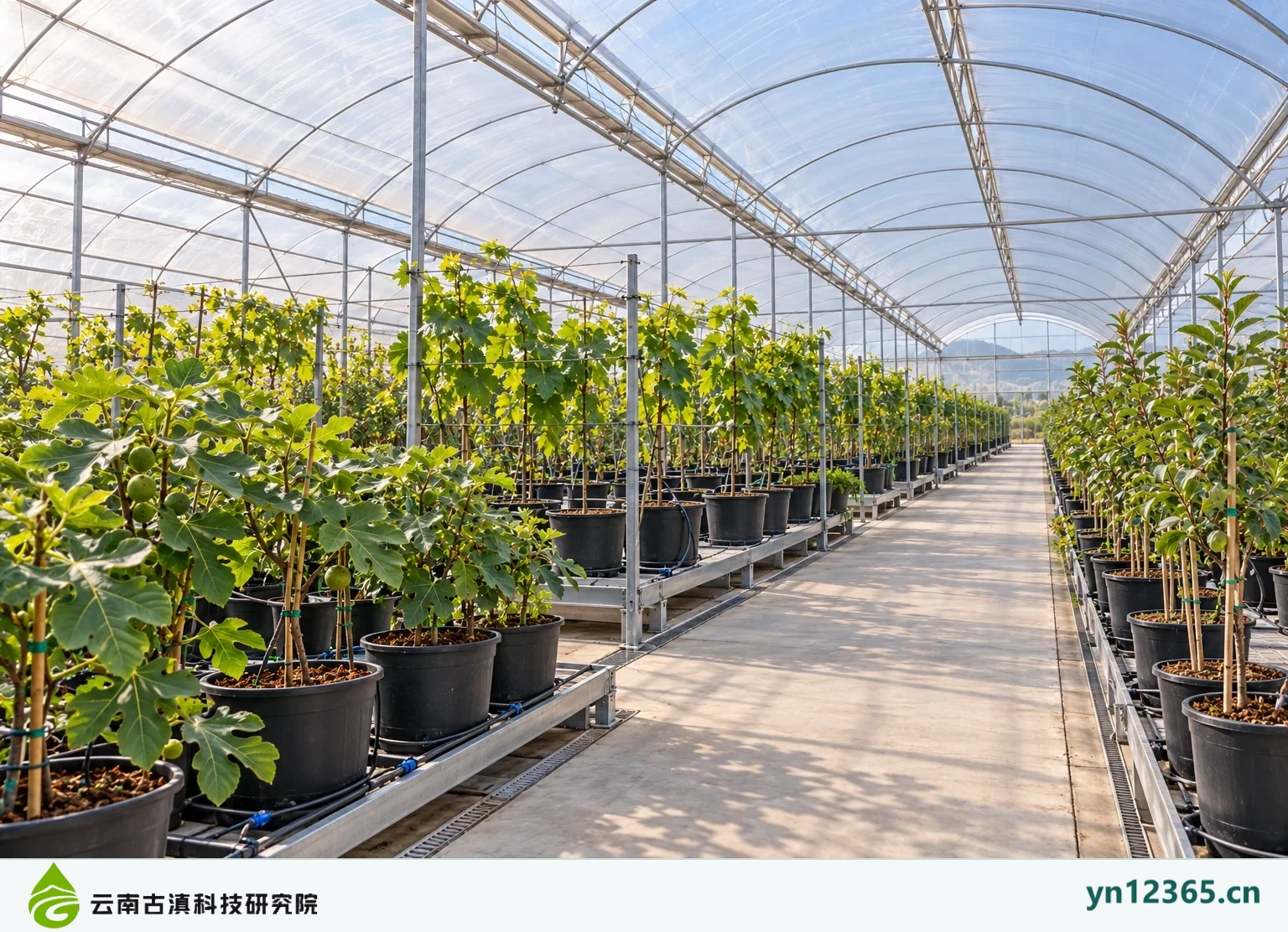
According to the operator, the site has about 20 mu of concrete-paved land, with water, electricity, roads, its own well and a transformer. The proposed greenhouse measures 200 metres × 30 metres, with a roof-plan area of about 6000㎡. Total site area and the footprint of this greenhouse are different measures. Ownership, actual boundaries, levels, paving and underground infrastructure still require site verification.
| Item | Planning basis |
|---|---|
| Greenhouse extent | 200 metres × 30 metres, approximately 6000㎡; these are not surveyed site dimensions |
| Road frontage | The 200-metre long side faces southeast, with an existing internal road about 6 metres wide in front. The road is outside the 6000㎡ greenhouse footprint |
| Crosswise layout | Provisionally organized into three gross strips of 10 metres each; the structural column grid and usable clear spans are to be determined separately |
| Lengthwise management | Four management zones, A, B, C and D, each 50 metres × 30 metres, with a gross planned area of about 1500㎡ including internal circulation and equipment positions |
| Access and maintenance | A provisional 2-metre working strip at the front and 1-metre maintenance strip at the rear are both within the 30-metre depth. Clear widths require detailed design |
| Construction stage | Planning and preparation; structure, foundations, ventilation, drainage and applicable formalities require specialist verification |
The four management zones support batch records and staffing. They do not mean four structurally independent greenhouses, nor that curtains can completely prevent disease transmission. Rear boundary foundations, rainwater facilities and maintenance access must be accommodated within the site’s own boundary, without shifting access or drainage needs onto neighbouring land.
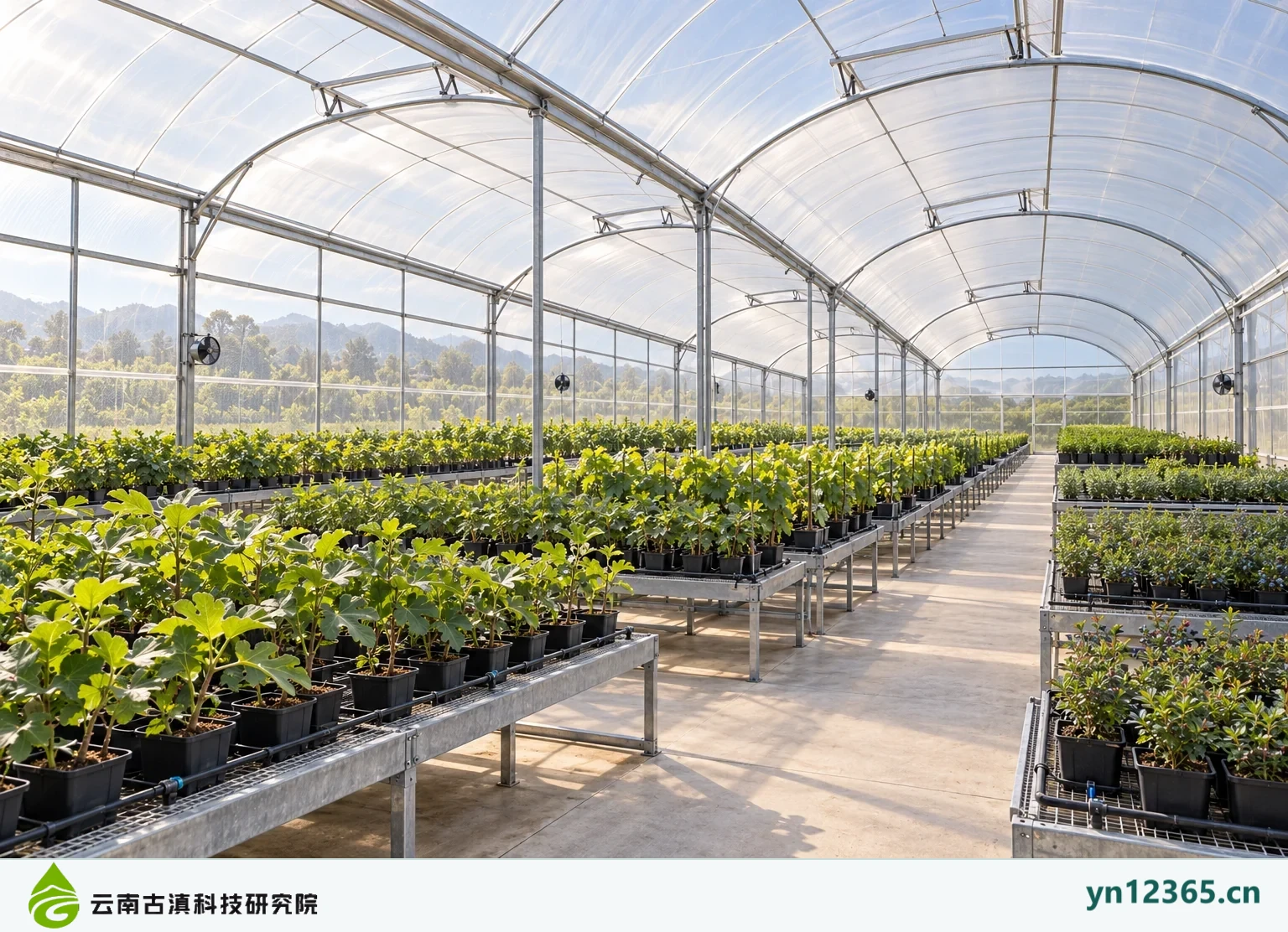
Dividing the four zones: distinguish production stages before allocating varieties
| Management zone | Proposed function | Questions to address first |
|---|---|---|
| Zone A | Propagation, rooting and batch hardening, with a separate observation area for incoming material | Mother-stock sources, propagation methods, tool hygiene and batch traceability |
| Zone B | Separate growing areas for fig, grape, passion-fruit and other fruit-tree seedlings | Varietal suitability, healthy material and local seasonal conditions |
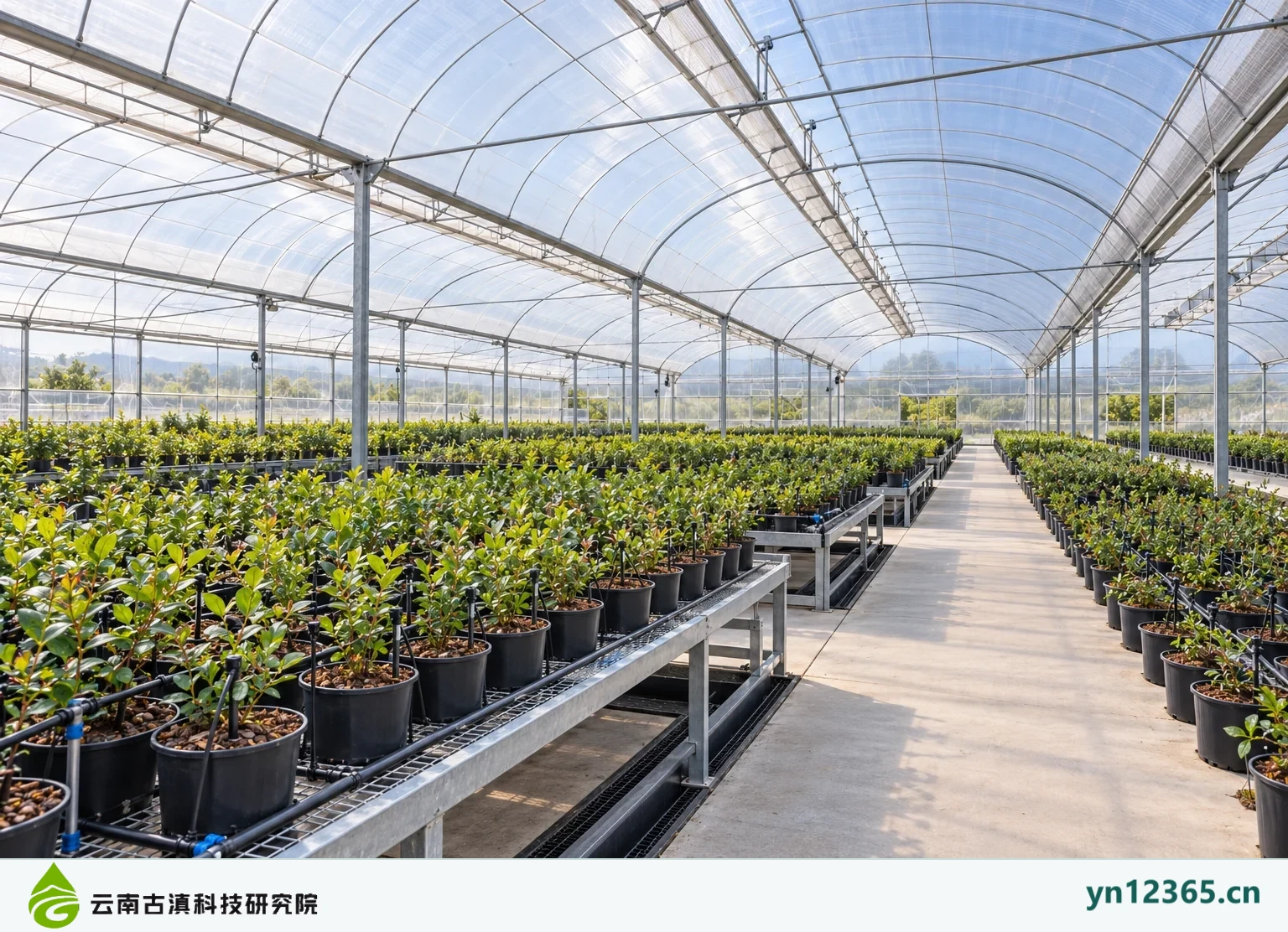
| Zone C | Independent water and nutrient management for blueberries, substrate monitoring and drainage sampling | Separate records for source-water alkalinity, substrate and root-zone conditions |
| Zone D | Growing fruit trees in containers, grading and independent comparative water trials | Container specifications, water-use records and experimental controls |
Fig, grape, apple, blueberry and passion fruit are proposed areas of investigation, not a product list backed by established, reliable seedling supply. Different crops cannot share one unvalidated set of cutting-propagation and fertigation parameters. Apples are primarily planned around suitable rootstocks and scions for grafting; direct cuttings from ordinary apple branches are not assumed to be the standard mass-production method. Other varieties also require checks of material sources, health and propagation conditions.
Well-water treatment: test first, select equipment afterwards
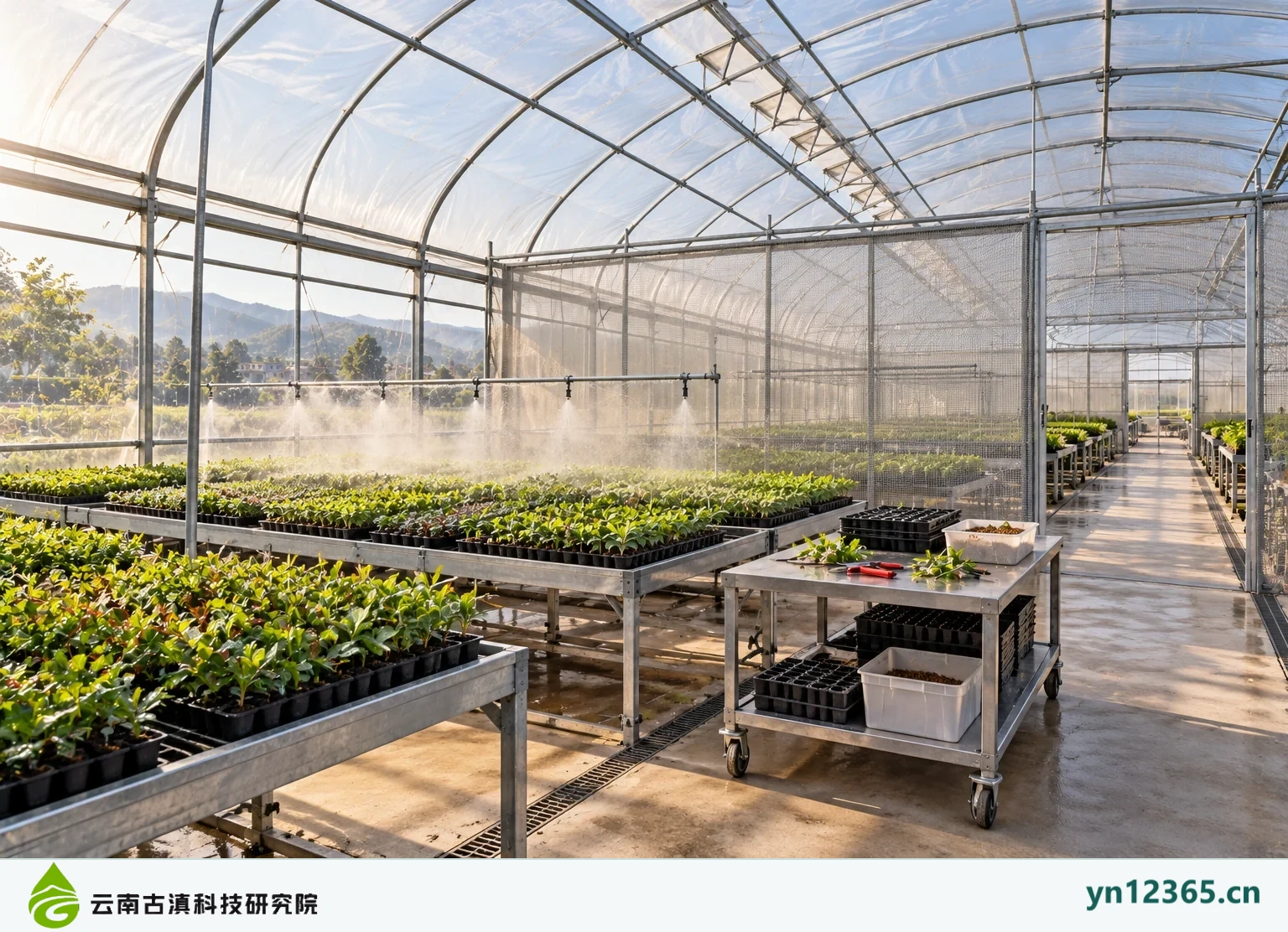
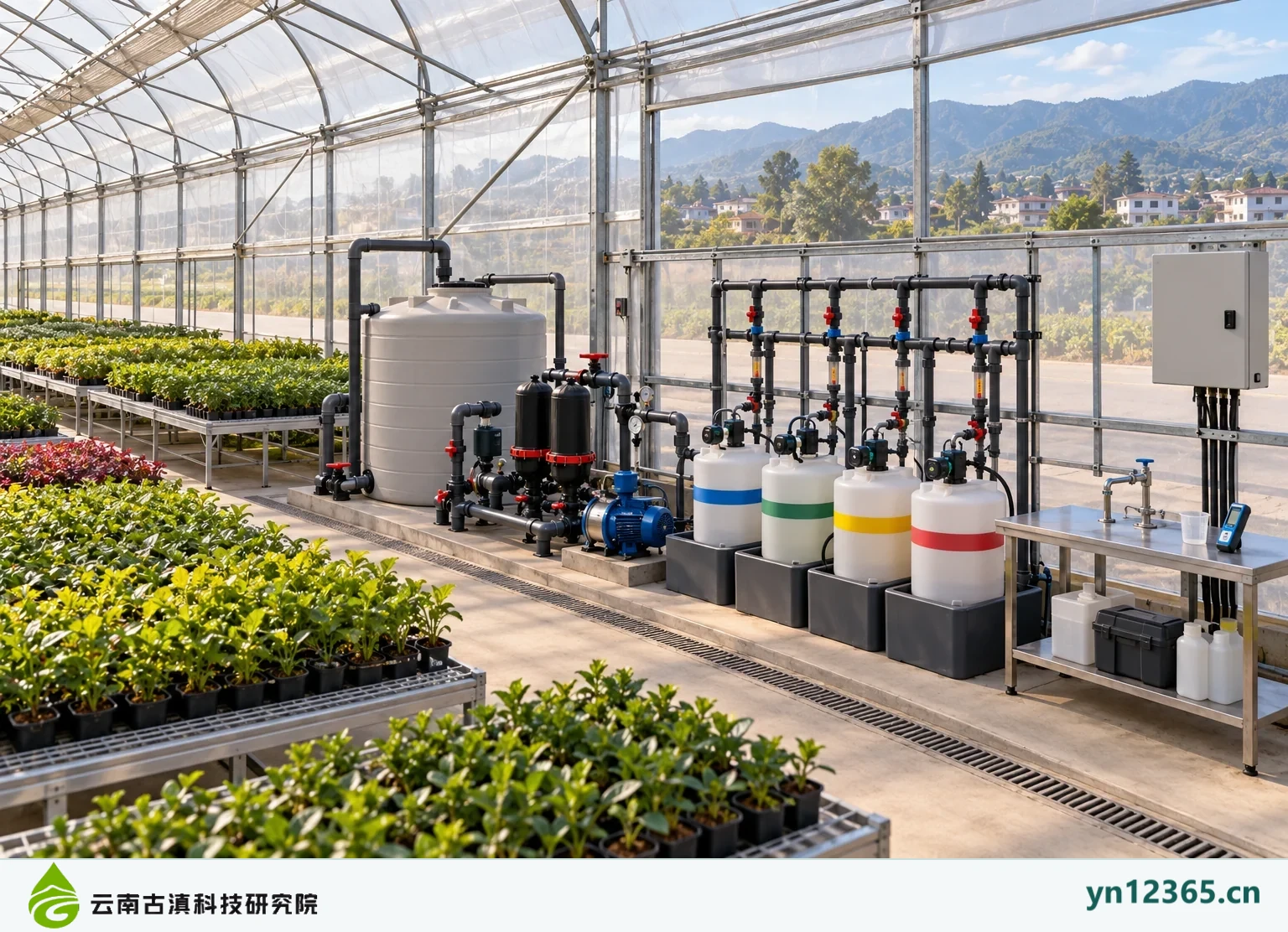
Agricultural-water processes should not be chosen from TDS alone or an equipment image. The plan is first to test well-water pH, EC, alkalinity and relevant constituents such as sodium, chloride, calcium, magnesium, iron and manganese, then consider particle filtration, necessary treatment or blending for the intended use. Microbiological risks, where relevant, must also be assessed for the point of use. Whether to use reverse osmosis, how much water to treat and how to blend afterwards all depend on testing and production needs.
Neither sodium-ion softening of all greenhouse well water nor exclusive use of RO water is the default. The plan uses shared pretreatment, zoned valve assemblies and suitable nutrient-mixing branches for each zone. The domestic drinking-water branch is separated from agricultural fertigation, with appropriate backflow protection. Main and branch pipes, pumps and storage must be sized for actual flow, head and pressure losses, rather than copying residential pipe sizes.
Hydrogen-rich water and nanobubbles: start with small, reproducible trials
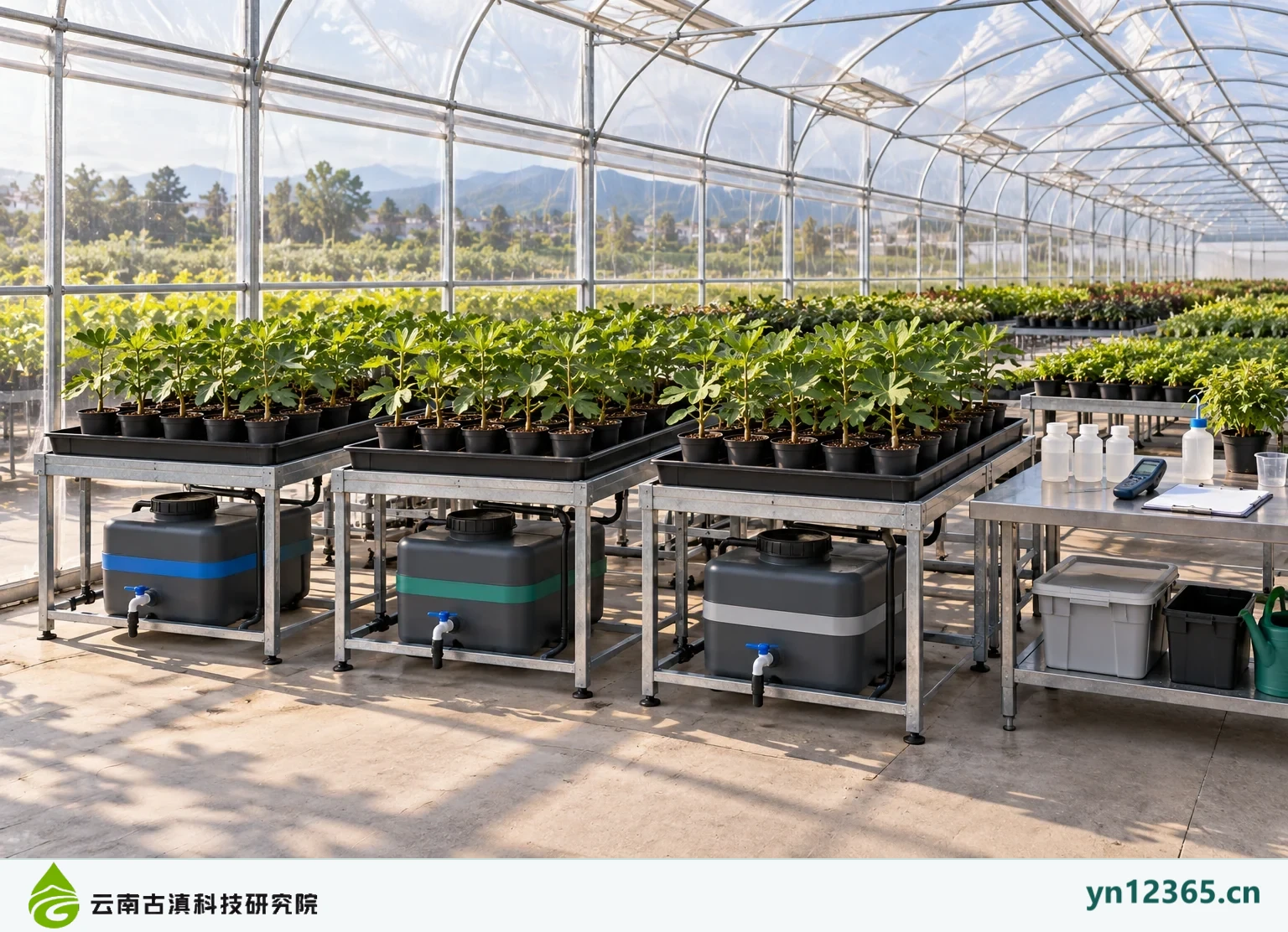
Hydrogen-rich water, nanobubble water and postharvest-preservation water are potential future research directions. The site currently has no trial data supporting claims of improved rooting, higher yields or longer freshness. Nursery irrigation, container root-zone water and postharvest treatment are different uses and require separate trial designs.
The initial plan is to use a small amount of healthy material of the same variety, batch and substrate under similar environmental conditions. Group A would use suitable conventional nursery water; group B, optimized base water; and group C, the same base water as B followed by hydrogen enrichment. Bubble treatment would be tested separately. Independent treatment units, randomized positions and repeated batches would be used, avoiding the error of treating several pots supplied by one tank as independent treatment replicates. Keep other management as consistent as possible and record treatment timing, actual water quality, quantities, root and growth performance, disease and inputs together. Specify measurement methods, sampling times and decay for hydrogen or bubble-related indicators. Merely switching on equipment, or a single ORP reading, does not prove effective treatment.
Use automation to support daily management, while retaining manual control
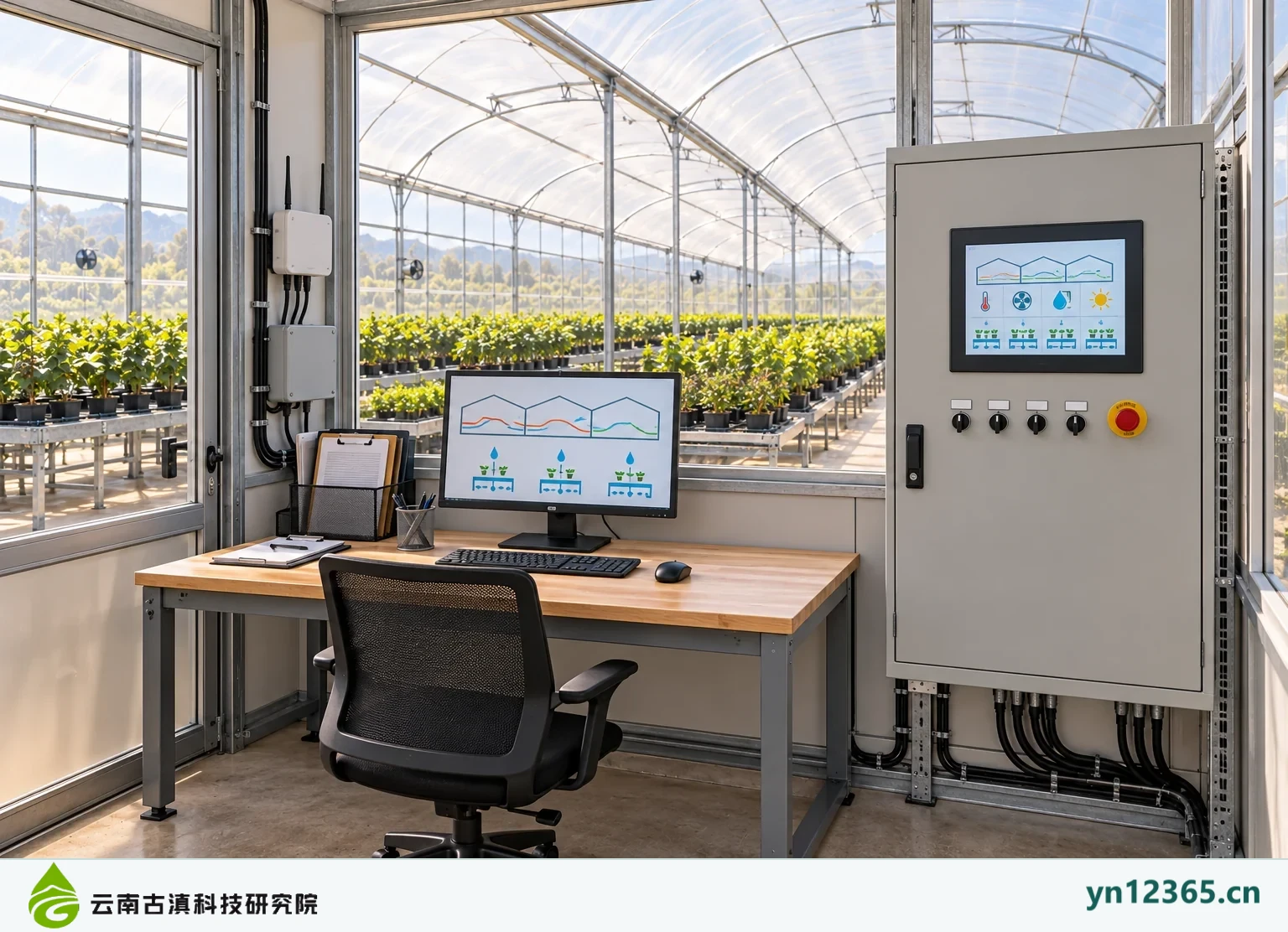
Temperature, humidity, light, zoned water use and necessary root-zone sampling records are proposed in budgeted stages. Clarify sensor positions, calibration, abnormal-reading checks and staff responses before arranging linked ventilation, shading or irrigation. Provide suitable manual measures for power failure, communication loss and sensor drift. The screens in the images are interface concepts, not evidence that a system has been developed, connected or accepted.
Check drainage, paving and preconstruction conditions together
Roof rainwater and production drainage are to be separated, with identifiable sampling points for blueberry and trial drainage. Reusing production drainage requires separate water-quality, pathogen and salinity assessments; do not reuse it directly across zones or reinject it into the site’s well. Rear gutters, downpipes and maintenance access must remain within the site boundary. Existing concrete paving is intended for containers, raised benches and circulation, but paving does not automatically provide an adequate greenhouse foundation. Structural loads, uplift resistance, connections and discharge conditions require separate design.
The plot is in the Changshui area. Before construction, verify applicable land-use, construction and well-water abstraction formalities, airport obstacle-clearance requirements and other site conditions. Concept drawings do not establish approval of formalities or height. There is currently no actual construction quotation, and this article gives no guaranteed construction cost, return or payback period.
Phased development: make one batch work before deciding how quickly to expand
- Complete the site survey, paving and drainage checks and well-water testing; establish mother-stock sources and long-term responsibility.
- Develop first-phase facilities around small-batch propagation and growing, and obtain comparable quotations for structure, utilities, fertigation and benches.
- Run one batch first, recording survival, growth, disease, labour, water, fertilizer and costs. Do not rush to fill 6000㎡ before problems are understood.
- Once traceable batch and water-use data are available, assess expansion of the container-plant business and provision of equipment and water-treatment services to growers.
Frequently asked questions
Is this a completed customer project?
No. This is a planning and preparation feature for GUDIAN Water’s own site. There are no records confirming that construction has started, equipment has been installed, production has begun or trial results have been obtained. The images are AI design visualizations. Future updates will use actual construction and testing records.
Will all 6000㎡ of greenhouse area hold plants?
No. The 6000㎡ figure is the planned roof projection of a 200-metre × 30-metre greenhouse. Internal aisles, maintenance, equipment and working positions are also needed. Usable bench area and production capacity can only be calculated after the actual column grid and layout are defined.
Does all well water need RO or softening before nursery use?
That cannot be predetermined. Test the source water and identify the crop, substrate and use first, then assess filtration, necessary treatment, blending and zoned fertigation. Neither sodium-ion softening nor full-flow RO is the default process for this project.
Will the five fruit-crop groups use the same cutting and fertigation methods?
No. Apples are primarily planned for grafting with suitable rootstocks and scions. Fig, grape, blueberry and passion fruit each require checks of healthy material and suitable propagation conditions. Blueberries are planned for independent water and nutrient management, with parameters determined through testing and small trials.
Can the effects of hydrogen-rich or nanobubble water be demonstrated now?
The site has no such data yet. Small trials with controls and repeated records are planned. There are currently no promises of rooting stimulation, yield increases, disease resistance or freshness duration, and visualizations are not evidence.
Related information and discussion
- Blueberry irrigation water and treatment requirements
- Flower-growing irrigation and water-preparation requirements
- Organizing integrated irrigation and fertilization needs
- Yunnan regional service information
- Discuss well-water and agricultural-water options
To discuss a similar site, provide the location, water source and test information, planned crops, containers or substrates, phased areas, water-use periods and existing facilities. GUDIAN Water will discuss treatment and supporting arrangements against actual conditions. This preparation record does not replace project-specific design and acceptance.
Technical reading sources
- UMass Extension: testing greenhouse irrigation water
- UGA Extension: managing healthy blueberry softwood-cutting material
- UF/IFAS: container blueberry production
- Extension: apple rootstocks and graft propagation
Project status update: 2026-10-23. Site conditions are based on the operator’s account. References provide technical background, not proof that this site has completed the corresponding verification or received institutional endorsement.