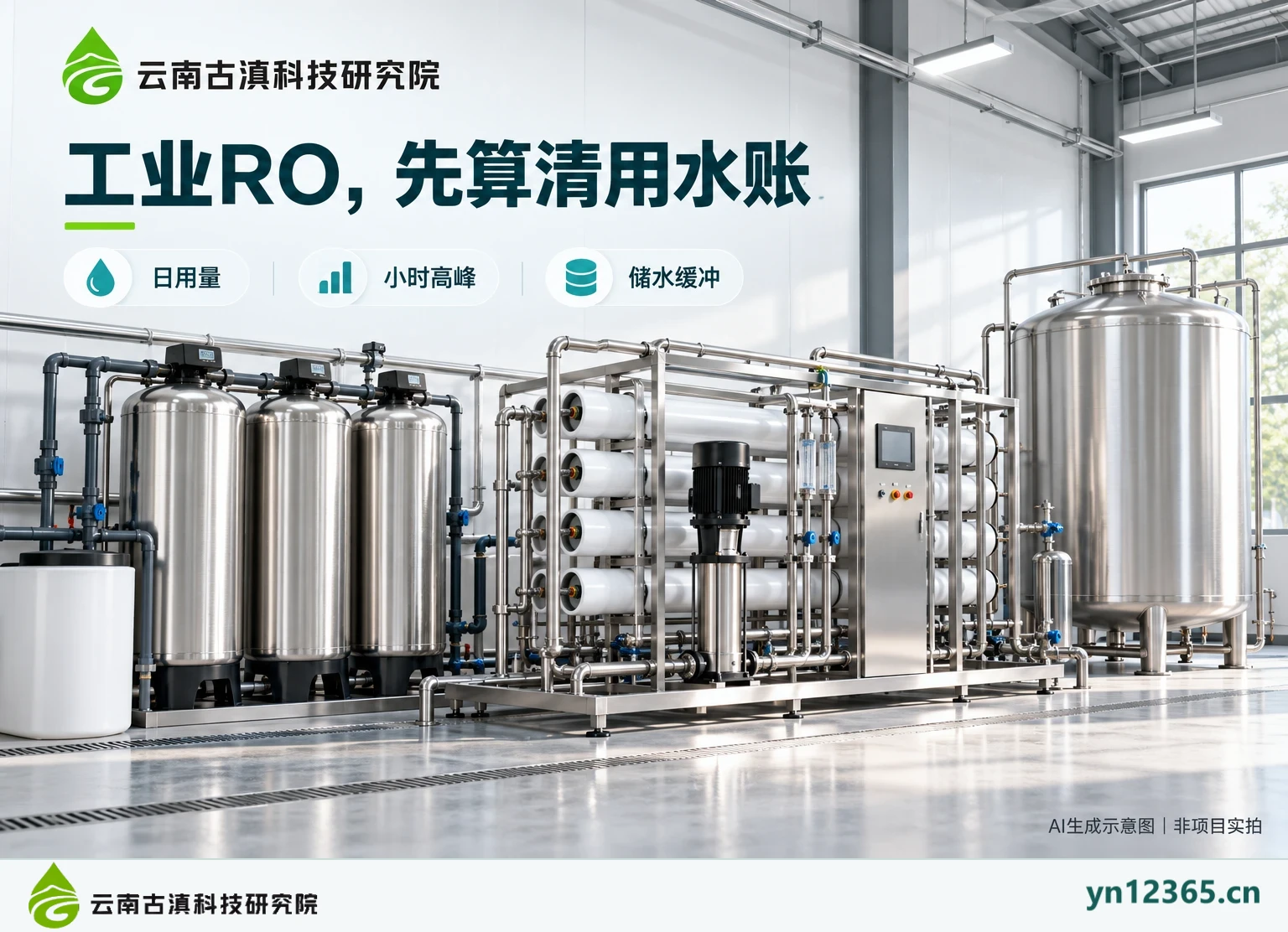
Document type: application plan. The illustrations on this page are AI-generated diagrams, not project photographs or specific models offered for supply.
Daily demand sets the average water production task; hourly peaks determine supply arrangements. Calculate them separately before comparing RO, storage and pump configurations.
Give production and purchasing teams the same water-use schedule first
A factory saying “we need twenty cubic metres of water a day” does not yet give a supplier enough information to size the complete system. Ask how many hours a day water can be produced, whether demand is concentrated in one shift, and whether stored water can cover cleaning or maintenance downtime.
Calculate water production and supply separately to make quotations easier to compare. The same daily demand, used slowly and continuously or concentrated into a short period, requires different storage, pumps and control arrangements.
A calculation example you can follow
The following numbers illustrate arithmetic only. They are not customer site data, supply specifications or a final engineering selection.
| Known conditions | Calculation | Meaning |
|---|---|---|
| Daily demand 20m³; 8h available for production | 20÷8=2.5m³/h | Theoretical average net water production task, before downtime and allowance |
| Peak demand 5m³/h for 15min | 5×15÷60=1.25m³ | Water used during this period |
| Production at 2.5m³/h at the same time | 2.5×15÷60=0.625m³ | New water produced during this period |
| Difference between demand and production | 1.25-0.625=0.625m³ | If there is no other make-up supply, this is the shortfall that usable stored water or other provision must cover |
0.625m³ is the net shortfall in this particular period, not the tank nameplate capacity. Also check the usable level range in the tank, demand at other times, maintenance allowance, pump supply capacity and water storage management.
RO performance also varies with temperature, feedwater composition and recovery. State the design conditions when comparing quotations. When assessing a later decline in permeate production, use normalisation analysis following the manufacturer’s method.[R1]
Clarify four groups of conditions before requesting a quotation
| Conditions | Information to provide | Confirmation required |
|---|---|---|
| Feedwater and use | Water source, report date, minimum water temperature and downstream process requirements | Pretreatment task and the basis for accepting product water |
| Timing and peaks | Daily volume, demand by period and hours available for production | Calculate net system output, storage and supply separately |
| Site conditions | Power supply, footprint, drainage, access and maintenance space | Installation coordination and delivery boundaries |
| Records and acceptance | Flow, water quality, sampling points, instruments and recording frequency | Compare under the same conditions, rather than comparing only equipment names or one parameter |
An enquiry can be worded like this
“The project is in ____, for ____, with ____ feedwater. Estimated daily demand is ____m³; peak demand is ____m³/h for ____ minutes. Water can be produced for ____ hours, and existing usable storage is ____m³. Please describe system water production, storage and supply, site coordination and acceptance conditions separately.”
Frequently asked questions
Can I divide daily demand by operating hours and buy an RO system with that output?
This is the arithmetic starting point for the average net production task. Actual conditions, downtime, maintenance and peak supply arrangements must also be considered; the result is not a final equipment specification.
The example gives a 0.625m³ shortfall. Is a tank of the same capacity sufficient?
No. That shortfall is only the difference between demand and production in the specified 15-minute period. Usable tank volume, other periods, maintenance allowance and supply capacity still need checking.
Can an RO membrane manufacturer’s rated flow be taken as a complete-system output commitment?
No. A single element’s test conditions differ from complete-system design, feedwater and operating conditions. System capacity must be confirmed by the corresponding configuration documents and agreed acceptance conditions.
Related information and enquiries
Industrial RO equipment selection information · Contact GUDIAN Water to discuss this requirement
Technical references
R1 · DuPont — Reverse Osmosis (RO). General technical explanation, not a design or acceptance value for a specific GUDIAN Water system.
References checked: 2026-10-25. Application plans and manufacturer references help organise requirements; actual supply, models, delivery and acceptance must be confirmed against the documents for this order.
Related illustrated information in this batch: Industrial RO equipment selection information. Earlier information: View the original product or guide.