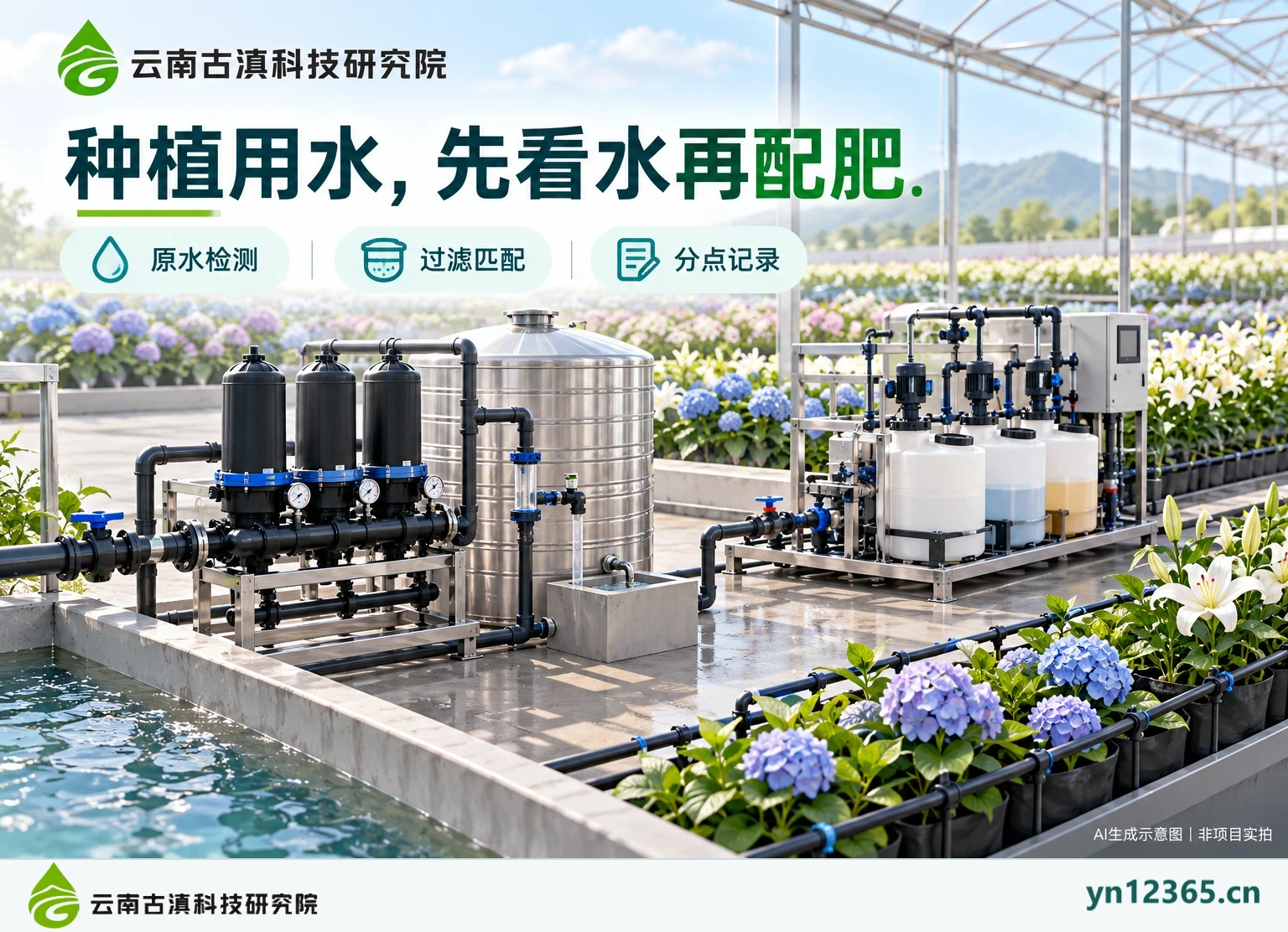
Document type: application plan. The illustrations on this page are AI-generated diagrams, not project photographs or specific models offered for supply.
First identify the water-use stage, then record EC, pH, alkalinity and key ions. Filtration protects drip irrigation; testing and crop objectives determine whether RO is needed.
First, state where the water is used
For lilies, hydrangeas and other crops, “water for flowers” is not a sufficient description. Identify source-water treatment, nutrient-solution preparation, drip supply and return-solution management separately. Postharvest vase care is a different task again.
An EC or pH reading is easier to discuss when accompanied by the sampling point, time, instrument and crop stage. Mixing up source-water and post-fertiliser readings can make normal nutrient-mixing changes look like a water-treatment problem.
Distinguish what these three measures tell you
| Measure | What it helps assess | How to record it |
|---|---|---|
| EC | Changes associated with overall salt content; not a substitute for testing specific ions | State mS/cm or μS/cm, measuring point and temperature-compensation settings |
| pH | Acid–base condition at the time of measurement | State instrument calibration, sampling point and measurement time |
| Alkalinity | The water’s acid-neutralising capacity and its long-term effect on substrate pH | State the laboratory reporting basis, such as mg/L as CaCO₃ |
Greenhouse references discuss salinity, pH and alkalinity as separate dimensions. Crop sensitivity to salinity also depends on species, growth stage and growing conditions.[R2] This plan therefore does not give a single universal set of acceptance values for all Yunnan crops.
Filtration and desalination address different tasks
When choosing filters, give the designer information on suspended solids, silt and biological clogging risks in the source water, along with the dripper manufacturer’s requirements. Whether dissolved salts call for RO, blending or other management must be considered separately against water quality and crop objectives.
Irrigation equipment manufacturers emphasise that checking source water during planning and in different seasons helps establish clogging-risk and maintenance arrangements.[R3] Filter type must also match system hydraulics; a fixed filter package cannot be selected solely by planted area.[R4]
Make the test results comparable across stages
| Measuring point | What to record this time | Who should review it with you |
|---|---|---|
| Source water | Source, season, test date, EC, pH, alkalinity and relevant ions | Testing provider and water-treatment designer |
| Treated water | Corresponding operating conditions, equipment status and target measures | Water-treatment supplier |
| After nutrient mixing | Mixing records, measuring point and crop stage | Growing manager or agronomist |
| Zone ends and return solution | Irrigation period, zone, performance at line ends and abnormalities | Irrigation designer and growing manager |
An enquiry can be worded like this
“The project is in ____, the crop is ____, the growth stage is ____, the source water is ____, and existing reports are ____. Daily and zone peak water demand is ____, the dripper model is ____, and the main current issue is ____. Please list source-water treatment, protective filtration, storage and supply, and integration with nutrient mixing separately.”
Frequently asked questions
Is RO-purified water suitable for every flower crop and every growth stage?
There is no universal answer. Consider source water, crop, substrate, nutrient programme and management objectives. Treated water must also fit subsequent nutrient management.
If EC and pH are available, do I still need to consider alkalinity?
They must be understood separately. EC, pH and alkalinity mean different things; a single EC or pH reading cannot replace alkalinity and required ion tests.
Can greenhouse area alone determine filter specifications?
No. Source-water risks, actual flow, dripper requirements, available pressure and backwashing conditions must also be checked.
Related information and enquiries
Equipment selection information for crop water supply · Contact GUDIAN Water to discuss this requirement
Technical references
R2 · Water Quality in Greenhouses. A Canadian greenhouse reference; its numerical tables are not treated here as acceptance criteria for Yunnan lilies, hydrangeas or other crops.
R3 · Drip Irrigation maintenance: what you need to know. Determine maintenance from the actual dripper, filter and system documents. No universal dosing recipe or fixed backwash threshold is quoted.
R4 · Filtration 2024 v4.0 — Product Catalog. Only general selection principles are paraphrased; manufacturer images, tables, packaging and engineered structures are not copied.
References checked: 2026-10-25. Application plans and manufacturer references help organise requirements; actual supply, models, delivery and acceptance must be confirmed against the documents for this order.
Related illustrated information in this batch: Equipment selection information for crop water supply. Earlier information: View the original product or guide.