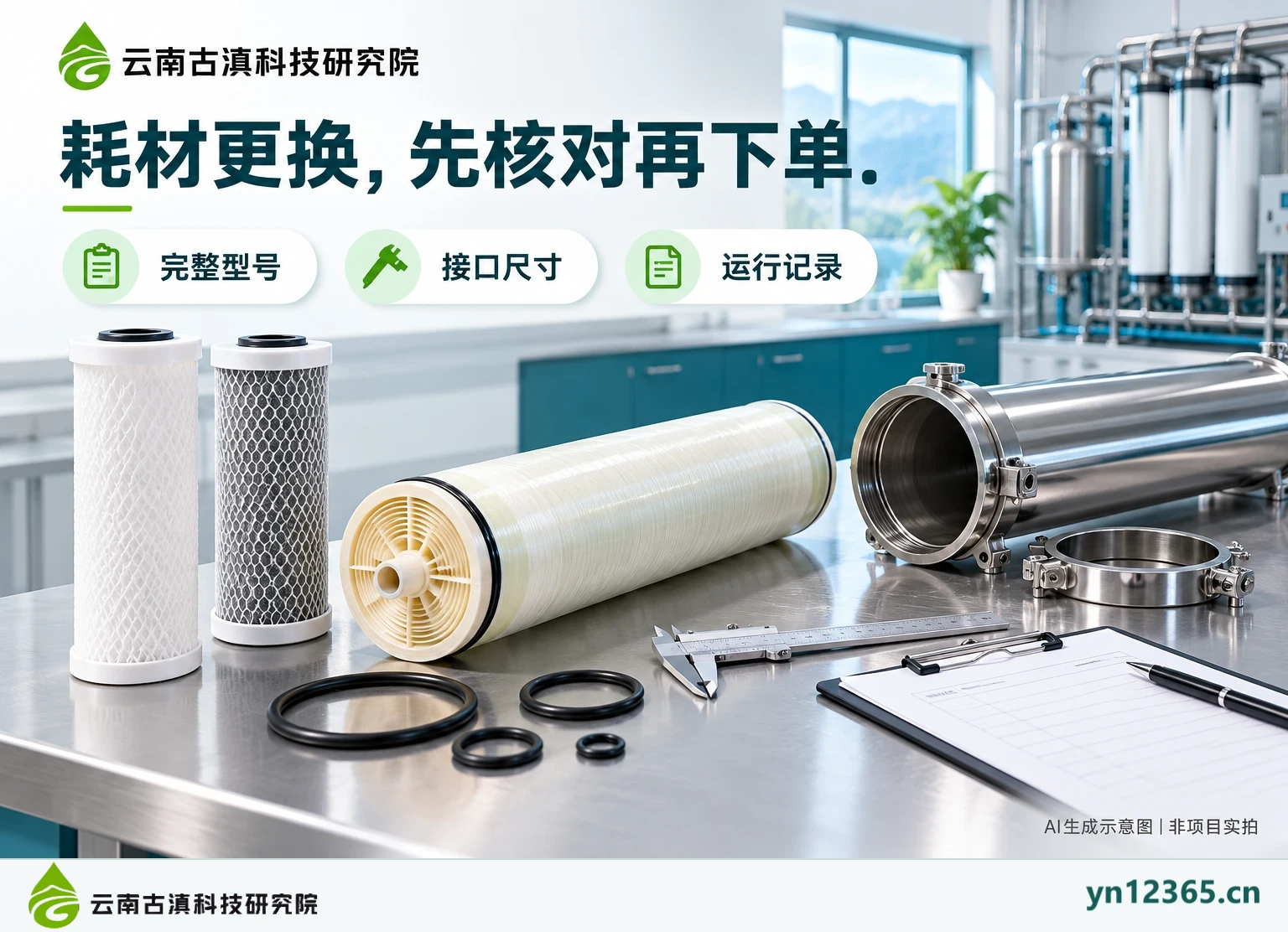
Document type: application plan. The illustrations on this page are AI-generated diagrams, not project photographs or specific models offered for supply.
Bring the original model, connections, operating conditions and records before and after replacement. Distinguish changed conditions, upstream restrictions and component issues before deciding on purchasing or maintenance.
Describe exactly what needs replacing first
A photograph of an old cartridge alone is often insufficient to identify a compatible replacement. A complete brand and model, label and batch, filter or membrane housing details, connection photographs and existing equipment documents are more useful.
Length and colour in a photograph can help with a search, but cannot establish identical materials, connections, seals, filtration rating or performance. Flag anything unconfirmed before ordering, rather than discovering on delivery that the part does not fit or is unsuitable.
If output falls, check that operating conditions are comparable first
Collect feedwater temperature and pressure, permeate and concentrate flows, relevant conductivity readings, valve positions or operating mode at the time, and instrument condition. DuPont’s general references explain that changes in temperature and feedwater composition affect RO performance; normalisation can help distinguish operating-condition changes from performance changes.[R1]
One day’s production volume or one conductivity reading therefore cannot establish that a membrane is beyond use. Refer abnormalities to the service personnel for that equipment, using manufacturer documents, actual configuration and historical records.
Prepare these four groups of information before purchasing
| Information | Minimum handover details | Purpose of the check |
|---|---|---|
| Identity | Complete model, batch, label and manual | Avoid treating similar names as the same product |
| Connections | Ends, seals, housing and original assembly relationships | Confirm compatibility of dimensions, structure and materials |
| Operation | Water temperature, flow, pressure, conductivity and time the abnormality began | Provide a basis for assessment beyond “poor performance” |
| Replacement handover | New-part batch, installer and restart records | Keep traceable records and a comparable initial operating baseline |
Deliver maintenance work together with its records
Qualified personnel must shut down, isolate and depressurise equipment according to its procedures before replacing pressure-containing parts. Follow the corresponding documents for cartridge or membrane replacement, flushing and return to use. This article does not provide universal dismantling, modification or chemical-cleaning steps across models.
Afterwards, record the new part’s model, batch, date and operating data under comparable conditions. Sign off “installed” separately from “meets agreed operating conditions” to make later abnormalities easier to trace.
An enquiry can be worded like this
“The equipment is ____, the original membrane/cartridge model is ____, the filter or membrane housing is ____, and the last replacement was ____. The issue began at ____; operating conditions and readings are in the records. Please check compatibility first, then list replacement parts, seals, service and return-to-operation requirements separately.”
Frequently asked questions
Can cartridges of the same length and colour be interchanged directly?
Appearance alone cannot establish compatibility. Check the complete model, end and seal structure, filtration rating, material and applicable conditions.
Should a membrane be replaced immediately if RO flow drops?
That alone is not enough to decide. First check temperature, pressure, feedwater composition and operating status, then analyse using normalisation and the relevant manufacturer references.
What records should be kept after replacement?
At minimum, keep the new part’s model and batch, date, installation handover and initial operating records under comparable conditions. Agree return-to-use and acceptance requirements using the corresponding equipment documents.
Related information and enquiries
RO membrane and filter cartridge purchasing information · Contact GUDIAN Water to discuss this requirement
Technical references
R1 · DuPont — Reverse Osmosis (RO). General technical explanation, not a design or acceptance value for a specific GUDIAN Water system.
References checked: 2026-10-25. Application plans and manufacturer references help organise requirements; actual supply, models, delivery and acceptance must be confirmed against the documents for this order.
Related illustrated information in this batch: RO membrane and filter cartridge purchasing information. Earlier information: View the original product or guide.